Something rather unexpected happened recently at the end of my morning Yi Jin Jing practice. I had been working through the twelve movements, which I have only been learning for a couple of weeks, and was conscious that the exercises required a little more physical effort than usual. Nothing particularly strenuous, but there was a recognisable sense of having worked the body, not unlike the sensation that sometimes follows a session of yoga. Yet when the movements finished, rather than experiencing the familiar relief of having completed an exercise routine, I became aware of an unusual stillness. It was both physical and mental, a sense of being entirely centred, and yet it did not feel like an absence of activity. On the contrary, the stillness seemed full of potential. I was not preparing to move, but movement remained entirely available. There was no particular intention to act, yet nothing about the experience felt passive.
It is difficult to describe such experiences without reaching for metaphors, and perhaps that is part of the problem. The language available to us for describing exercise tends to concentrate on what the body does: muscles contract, limbs extend, joints rotate, breathing accelerates, and the cardiovascular system responds to physical demand. Alternatively, when discussing meditation, we are inclined to describe states of consciousness: calmness, relaxation, concentration or the absence of distracting thoughts. Neither vocabulary seems quite adequate to what I experienced, since the stillness seemed to belong neither to the body nor to the mind in isolation. It was a quality of the relationship between them.
This experience has prompted me to revisit a question that has accompanied much of my practice of taiji, qigong and standing meditation: what does it mean to feel through a movement rather than simply perform it? The question is deceptively simple, because it suggests that movement is not only a physical activity but also a means of perception. We do not merely move a body that we already know; through moving, we encounter aspects of that body that might otherwise remain unavailable to awareness. With the Yi Jin Jing, I am beginning to suspect that the significance of the practice may lie as much in the development of this perceptual capacity as in the performance of the movements themselves.
The strange history of transforming the sinews
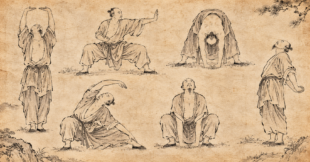
The Yi Jin Jing (易筋經), commonly translated as the Classic of Transforming the Sinews, occupies an unusual position in Chinese martial and cultivation culture. It is at once a recognisable system of bodily exercises, a text with a complicated and contested history, and an almost mythical object within Chinese popular fiction. Indeed, a recent conversation with someone who had grown up watching wuxia films and television dramas revealed that they had assumed the Yi Jin Jing was an entirely fictional martial arts manual, the kind of legendary book over which rival practitioners might fight and from which extraordinary powers could be acquired. They were surprised to discover that people actually practised something called the Yi Jin Jing.
This apparent confusion between fiction and history is more revealing than it might initially seem. The Yi Jin Jing has long been associated with extraordinary possibilities of bodily transformation. Its traditional origins are attributed to Bodhidharma, the Indian Buddhist monk associated with the development of Chan Buddhism and the Shaolin monastery. According to the familiar legend, Bodhidharma developed the exercises to strengthen monks whose bodies had become weakened through prolonged meditation. The practice therefore appears as a means of preparing the body for spiritual cultivation, establishing an intimate relationship between physical discipline and contemplative activity (Shahar, 2008).
The historical evidence, however, suggests a rather different story. Meir Shahar’s The Shaolin Monastery: History, Religion, and the Chinese Martial Arts (2008) situates the emergence of the Yi Jin Jing within the late Ming period, when martial practice, therapeutic exercise and religious cultivation were increasingly articulated as interconnected activities. The date 1624 is frequently associated with the text, although Pei-San Ng’s substantial study of Chinese internal martial arts (2016) demonstrates that its precise textual origins are more complicated than this familiar chronology might suggest. What is clear is that the Yi Jin Jing cannot be treated as an unchanging sequence of exercises transmitted intact from the sixth century. It is better understood as an evolving tradition of texts, practices and interpretations, shaped by changing understandings of the body and its capacities (Ng, 2016; Shahar, 2008).
Ng’s research is particularly interesting in this context because it includes an English translation of the illustrated Yi Jin Jing exercises published in Wang Zuyuan’s Neigong Tushuo (1881). Her wider argument explores the ways Chinese internal martial arts came to articulate particular conceptions of strength, bodily transformation and cultivated power during the nineteenth and early twentieth centuries. These conceptions cannot be reduced entirely to the language of modern anatomical science, although neither should they be placed beyond scientific investigation. They belong to a historically situated understanding of the body in which strength is not necessarily understood as the isolated capacity of individual muscles, but as something developed through the organisation and cultivation of the person as a whole (Ng, 2016).
There is a temptation here to draw a straightforward line from historical descriptions of internal transformation to contemporary scientific discussions of connective tissue, neuromuscular coordination or proprioception. Such comparisons can be illuminating, but they also risk imposing modern explanations upon concepts that emerged within different philosophical and practical traditions. The historical Yi Jin Jing is not simply an early manual of biomechanics, any more than contemporary neuroscience can be treated as a confirmation of traditional theories of qi. Nevertheless, the encounter between these different ways of understanding the body raises questions that deserve to be explored.
From producing tension to listening to it
My own approach to the Yi Jin Jing is inevitably shaped by previous experience of taiji and neigong. In standing meditation, I have spent considerable time working with a quality of extension that connects different parts of the body. I might begin by stretching gently through the fingers, allowing that extension to develop through the hands, arms and shoulders into the back, while simultaneously attending to a similar relationship between the toes, legs and hips. The dantian, the lower abdominal centre associated with internal cultivation, provides an experiential point of organisation. Sometimes I feel as though the extension is drawn inwards towards that centre; sometimes it seems to emerge outwards from it. On other occasions, these apparently opposing movements are experienced simultaneously, as if opening and closing were complementary rather than sequential actions.
What makes this interesting is that the sensation of extension does not necessarily disappear when I release muscular effort. The body can continue to feel stretched or connected while particular muscles soften. In fact, the relationship between extension and release is frequently more revealing than either sensation considered independently. There is a delicate distinction between actively producing tension and allowing the sensation of connection to emerge through the organisation of the movement. Too much deliberate effort can make the body rigid, but an indiscriminate attempt to relax may dissolve the very connections that the practice seeks to cultivate.
Paul Cavel’s teaching of bend-and-stretch neigong provides one useful way of thinking about this distinction. Rather than treating stretching exclusively as the achievement of increased range of motion, Cavel (2023) describes an internal training process concerned with coordinated extension, release and the development of bodily connection. This is close to the way I have learned to work with tension in standing practice, although the Yi Jin Jing is now offering a different structure through which to investigate it. The twelve movements continually alter the configuration of the body, changing the relationships between limbs, torso, centre of gravity and direction of extension. A connection that feels obvious in one posture may become difficult to sustain in another, not necessarily because the body lacks strength but because the movement asks it to organise itself differently.
This has led me to reconsider the role of attention in practice. When learning a movement, the initial concern is often to reproduce its external form: the arms must extend in a particular direction, the hands assume a prescribed position, and the body follows a recognisable sequence. Such attention is necessary, but it can also become limiting if the exercise is understood only as the successful reproduction of its visible appearance. Once the basic movement becomes familiar, it is possible to begin attending to something less immediately apparent: the changing distribution of tension, the subtle adjustments involved in maintaining balance, or the way a movement initiated in one region of the body seems to alter the experience of another.
This is where I find the taiji concept of ting jin (聽勁), commonly translated as listening to force, particularly suggestive. In its martial context, ting jin concerns the capacity to perceive and respond to an opponent’s force through contact. I am borrowing the expression more broadly to describe an attitude of attentiveness towards the forces and sensations emerging through one’s own movement. Instead of simply asking how to generate a connected stretch, I begin to ask where that connection appears, how it changes, and what happens when I cease trying to control every aspect of it.
The distinction is subtle, because directing and listening are not necessarily separate activities. Attention influences movement, while movement continually produces new sensations that inform attention. I might begin with an intention to extend through the arms, only to discover that the most interesting change occurs in the back or legs. The sensation then invites an adjustment that was not part of my original intention. In this way, the practice becomes a continuous conversation between deliberate action and responsive perception.
This is not a claim that the body possesses an independent intelligence that somehow operates outside the nervous system. Rather, it recognises that bodily skill frequently involves forms of coordination and responsiveness that do not require every adjustment to be consciously planned. The more familiar we become with a practice, the more possibility there may be for intention and sensation to participate in a developing movement rather than simply imposing a predetermined result.
Loading, effort and the possibility of release
Thinking about internal connection has also made me more attentive to the relationship between physical loading and muscular rigidity. There can be a tendency, particularly in discussions of qigong, to emphasise relaxation so strongly that the importance of physical effort becomes obscured. Yet the Yi Jin Jing is not simply a relaxation routine. Its postures involve weight-bearing, muscular engagement, controlled extension, balance and sustained attention. The body is doing work, even when the movements appear slow and relatively gentle (British Health Qigong Association, n.d.-b).
The challenge is to distinguish the loading that contributes to the practice from unnecessary bracing. In biomechanical terms, bracing involves muscular co-contraction that increases stability, often by limiting movement. This can be useful, and there is nothing inherently undesirable about it. But sustained rigidity, particularly when combined with breath-holding, is a different physical demand from maintaining a responsive structure through moderate muscular engagement. The latter may allow the practitioner to experience connection without locking the body into a fixed arrangement. The traditional taiji concept of song (鬆) is relevant here, since release does not necessarily imply a complete absence of muscular activity. It may involve reducing effort that is no longer required while retaining the organisation necessary for movement (British Health Qigong Association, n.d.-a, n.d.-b).
Contemporary research into the physical effects of Yi Jin Jing offers some support for taking its loading characteristics seriously. A systematic review and meta-analysis published in 2024, drawing on ten randomised controlled trials involving 590 older adults, reported improvements in several measures of muscular strength and physical performance. These included aspects of lower-limb function and grip strength, although not all measured outcomes improved and the certainty of the evidence was limited (Zhang et al., 2024). The findings do not suggest that Yi Jin Jing is equivalent to conventional resistance training, but they do challenge any assumption that its apparently gentle movements are physically inconsequential.
There is also emerging research concerning the potential skeletal benefits of traditional Chinese exercise. Yang and Liu (2025) investigated resistance training, Yi Jin Jing and Baduanjin in older women receiving calcium and vitamin D supplementation. Their 24-week intervention reported improvements in lumbar spine bone mineral density and selected markers of bone metabolism in exercise groups compared with controls. The study cannot establish which individual movements produced those changes, nor can it isolate the effects of the exercise from every other aspect of the intervention. Nevertheless, it raises interesting questions about the loading demands of practices that are not ordinarily described in the language of resistance exercise.
An even more striking development appeared in Nature Neuroscience in 2026, when Cai et al. (2026) reported experimental evidence that controlled mechanical compression of the tibia could influence neurological recovery following brain injury. Working with animal models, the researchers investigated how mechanical stimulation of bone cells might initiate biological signalling associated with neuronal protection and recovery. Their findings implicated PIEZO1, a mechanosensitive ion channel in osteocytes, suggesting a pathway through which mechanical loading of bone may influence processes elsewhere in the body, including the brain.
This is fascinating research, although its relevance to Yi Jin Jing remains speculative. The study did not investigate qigong, taiji or standing meditation, and the specific mechanical intervention employed cannot be equated with the internal stretching sensations developed through neigong. Nor do the animal findings establish a treatment for human neurological injury. Nevertheless, the research adds to a growing understanding of the skeleton as an active biological system rather than merely a passive structure supporting movement.
It also complicates familiar distinctions between physical and neurological exercise. The body does not consist of entirely separate systems responding independently to different forms of activity. Mechanical loading, muscular coordination, sensory processing and neurological function participate in complex physiological relationships. Traditional cultivation practices have long been concerned with the integration of bodily processes, although contemporary science investigates these relationships through very different conceptual and experimental frameworks.
For my own practice, the immediate implication is more modest. Rather than regarding muscular effort as something to eliminate, I am interested in understanding how it contributes to the quality of movement. Loading may be useful, but more effort is not automatically better, and the strength of an internal stretching sensation is not necessarily a reliable indication of the mechanical load being applied to bone. The relationship between effort, extension and release is something to investigate attentively, not to intensify indiscriminately.
The sensing body and the possibility of transformation
The scientific literature on Yi Jin Jing has also begun to investigate neurological and cognitive outcomes. A randomised controlled trial by Luo et al. (2026) examined a structured Yi Jin Jing programme in people recovering from stroke, comparing its effects with stretching exercises. The researchers reported greater improvements in balance and several measures of gait following the Yi Jin Jing intervention. Another study, published by Sun et al. (2022), investigated Yi Jin Jing in patients experiencing post-stroke depression and reported improvements in depressive symptoms alongside changes in EEG measures of brain activity and connectivity.
Such findings are promising, but they require careful interpretation. Relatively small clinical trials do not establish a comprehensive explanation of the practice’s effects, and improvements in balance or neurological measures cannot be taken as proof of traditional theories of internal energy. Nevertheless, the comparison with conventional stretching raises an important question: what is distinctive about the particular way Yi Jin Jing coordinates bodily movement and attention?
One possibility concerns proprioception, the sensory processes through which we perceive bodily position, movement and force. Another concerns interoception, the perception and interpretation of internal physiological conditions. These are different but interacting dimensions of bodily experience, and both may be relevant to the sensations arising during slow, attentive movement. When I practise the Yi Jin Jing, I am not simply observing where my arms and legs are positioned. I am also attending to muscular effort, changing balance, breathing, internal sensation and the relationship between deliberate movement and the adjustments that occur without conscious instruction.
There is a growing literature on taiji and related practices that examines balance, proprioceptive accuracy and neurological function. A systematic review by Bertolini et al. (2025), for example, reported benefits of taiji for balance in older adults. A recent meta-analysis by Du et al. (2026) also investigated mindfulness-based movement interventions and proprioceptive accuracy, while cautioning that small-study effects and heterogeneity make the magnitude of the apparent benefit uncertain. Such findings are relevant to the Yi Jin Jing, although they should not be treated as interchangeable evidence for different practices. They suggest that sustained engagement with coordinated movement may influence aspects of sensorimotor function, but they tell us rather less about the lived experience of that coordination.
This is where the scientific and phenomenological questions begin to diverge. We may be able to measure improvements in postural control, changes in muscular activity or differences in brain connectivity, but these measurements do not necessarily explain what it feels like when a practitioner experiences a connected stretch through the body, or when the deliberate organisation of movement gives way to something more responsive and less consciously directed.
For me, this distinction is not a reason to reject scientific explanation. On the contrary, it suggests that different forms of enquiry may contribute to a more complete understanding of practice. Scientific research investigates measurable relationships and causal mechanisms. Reflective attention to experience investigates how those relationships are encountered and understood by the person practising. Neither perspective can simply substitute for the other.
The concept of enskillment is useful here because it recognises that learning a practice involves more than the acquisition of technical instructions. Over time, the practitioner develops new perceptual capacities through repeated engagement with the conditions of an activity. What initially requires deliberate attention may gradually become available as a more immediate form of bodily understanding. One learns not only how to perform a movement but also how to recognise the possibilities that the movement presents.
In this sense, the Yi Jin Jing may be understood as a form of embodied enquiry. Each posture establishes particular conditions through which the body can be encountered differently. The external movements provide a relatively stable structure, but the experience of performing them remains open to variation and discovery. A movement that feels effortless one morning may reveal unexpected resistance the next. A familiar extension may suddenly be experienced as a relationship between parts of the body that had previously seemed disconnected. The form remains recognisable, yet what becomes perceptible through it continues to change.
Returning to stillness
This brings me back to the experience that prompted the enquiry. After completing the twelve movements, I noticed a stillness that seemed neither passive nor empty. It was as though the body had ceased its deliberate activity while retaining a quality of organisation and readiness. I did not feel that I was preparing for movement, but neither did I feel that movement had become unavailable. The experience was one of potential without immediate intention.
There is a philosophical resonance here with the relationship between wuji (無極) and taiji (太極), concepts that appear throughout Chinese cosmological thought and are frequently invoked within internal martial arts. Wuji is commonly associated with undifferentiated potential, while taiji concerns the emergence of differentiation and the complementary relationships expressed through yin and yang. It would be inappropriate to claim that a particular sensation following exercise constitutes an objectively identifiable state of wuji. Nevertheless, these concepts offer a vocabulary through which the relationship between stillness and movement can be considered without treating them as simple opposites.
Movement and stillness are not necessarily mutually exclusive. Even when standing quietly, the body remains engaged in subtle adjustments of posture, balance and muscular activity. Equally, a person performing a slow movement may experience a remarkable degree of mental quietness. Within neigong, opening and closing, tension and release, movement and stillness can be experienced as mutually implicated qualities rather than discrete stages that follow one another.
Perhaps what I encountered at the end of practice was simply an unusually vivid awareness of that relationship. Having spent time attending to the body’s changing organisation through movement, I became conscious of a different quality of bodily availability when the movement ceased. This is a possible interpretation rather than a physiological explanation, and I would not want to claim more than the experience allows.
Indeed, I am reluctant to turn the stillness into something that the practice is supposed to produce. If I begin each session attempting to recreate it, I risk replacing an openness to discovery with the pursuit of a predetermined outcome. That would return me to the very problem with which the enquiry began: the tendency to impose upon the movement an expectation of what should happen, rather than remaining attentive to what actually emerges.
There is also a curious historical echo here. In its fictional life, the Yi Jin Jing is frequently represented as a manual through which extraordinary power might be acquired. Characters pursue it because they believe it contains something they lack. The real practice, at least as I am beginning to encounter it, seems to invite a rather different orientation. What becomes interesting is not the acquisition of some exceptional capacity, but the refinement of attention towards experiences that are already present, though perhaps insufficiently noticed.
This does not diminish the physical benefits of practice, nor does it mean that effort, strength and loading are unimportant. On the contrary, the movements involve real physical work, and the growing scientific literature suggests that this work may have meaningful effects. But the relationship between that work and the experience of practising remains more complicated than a simple progression from effort to measurable improvement.
I am beginning to think of the Yi Jin Jing less as a sequence of twelve exercises to be mastered and more as an evolving encounter with the possibilities of bodily organisation. The forms are important because they establish conditions within which something can be investigated. They invite extension, resistance, balance, coordinated effort and release, but they do not entirely determine how those experiences unfold. Through repetition, the practitioner may become more attentive to subtle variations in the relationship between intention and sensation, between directing movement and allowing movement to develop.
And perhaps that is what interests me most about the stillness I experienced. It did not feel like an end point or an achievement. It felt like the discovery that movement and stillness belong to a continuous field of possibility, one that cannot be reduced entirely to the external appearance of the exercise or to the physiological effects that science is beginning to measure.
For now, I have no desire to turn that discovery into a definitive explanation. I would rather carry the question back into the next practice, remaining attentive to what happens when the body extends, releases, settles and becomes available once again for movement.
The Yi Jin Jing may be a practice of transforming the sinews, but I am increasingly interested in the possibility that, through cultivating movement, we also transform our capacity to perceive.
Not simply learning what the body can do, but learning how to listen to what the body is doing.
And perhaps, occasionally, discovering a stillness full of potential.
References
Bertolini, R., Vercelino, R., Ferreira, L. F., & Telles da Rosa, L. H. (2025). Effects of Tai Chi Chuan on older adults’ balance: A systematic review with meta-analysis. Journal of Aging and Physical Activity, 33(1), 84–97. https://doi.org/10.1123/japa.2023-0423
Access / PDF: https://pubmed.ncbi.nlm.nih.gov/39244194/
British Health Qigong Association. (n.d.-a). The concordance in the exercise of the Health Qi Gong Yi Jin Jing. https://healthqigong.org.uk/info/?page_alias=yi_jin_jing_article_01_concordance
British Health Qigong Association. (n.d.-b). Practicing techniques of Health Qigong · Yi Jin Jing. https://healthqigong.org.uk/info/?page_alias=yi_jin_jing_article_12_practicing_techniques
Cai, Z., Zhang, Z., Wang, Y., Liu, S., Leng, J., Chu, Y., Liu, J., Fang, Y., Chen, B., Liang, W., Wang, H., Zhang, L., Zou, W., Yang, F., Song, Q., Lu, D., & Bai, X. (2026). Tibial bone compression promotes recovery after brain injury through osteocyte PIEZO1. Nature Neuroscience, 29, 2753–2768. https://doi.org/10.1038/s41593-026-02422-w
Access / PDF: https://www.nature.com/articles/s41593-026-02422-w
Cavel, P. (2023, April 11). Qigong for healing (Part 1 of 2). https://www.paulcavel.com/blog/qigong-for-healing-1
Du, S., Ai, G., Zhao, S., Ng, S. F., Siu, T. L., & Ning, Z. (2026). The effects of mindfulness-based interventions on proprioception: A Bayesian multilevel meta-analysis of evidence from randomized controlled trials. Mindfulness. https://doi.org/10.1007/s12671-026-02986-5
Access / PDF: https://link.springer.com/article/10.1007/s12671-026-02986-5
Luo, K.-L., Cheng, X.-P., Xie, L.-L., Jin, X.-M., Liu, X.-H., Wang, W.-Z., Chen, X.-Y., Ma, S.-J., & Hu, J. (2026). A traditional Chinese Yijinjing mind-body training program improves balance and gait in stroke survivors: A randomized controlled trial. Complementary Therapies in Medicine, 99, Article 103387. https://doi.org/10.1016/j.ctim.2026.103387
Access / PDF: https://www.sciencedirect.com/science/article/pii/S0965229926000701
Ng, P.-S. (2016). Strength from within: The Chinese internal martial arts as discourse, aesthetics, and cultural trope (1850–1940) [Doctoral dissertation, University of California, Berkeley]. eScholarship. https://escholarship.org/uc/item/6r34f83d
Access / PDF: https://escholarship.org/content/qt6r34f83d/qt6r34f83d.pdf
Shahar, M. (2008). The Shaolin monastery: History, religion, and the Chinese martial arts. University of Hawai‘i Press. https://doi.org/10.21313/hawaii/9780824831103.001.0001
Sun, P., Zhang, S., Jiang, L., Ma, Z., Yao, C., Zhu, Q., & Fang, M. (2022). Yijinjing Qigong intervention shows strong evidence on clinical effectiveness and electroencephalography signal features for early poststroke depression: A randomized, controlled trial. Frontiers in Aging Neuroscience, 14, Article 956316. https://doi.org/10.3389/fnagi.2022.956316
Access / PDF: https://pmc.ncbi.nlm.nih.gov/articles/PMC9400391/
Yang, Y., & Liu, H. (2025). Effects of resistance training, Yijinjing and Baduanjin exercise with oral Caltrate D on bone mineral density and bone metabolism in older women: A randomised controlled trial. BMC Complementary Medicine and Therapies, 25, Article 115. https://doi.org/10.1186/s12906-025-04849-3
Access / PDF: https://pmc.ncbi.nlm.nih.gov/articles/PMC11948780/
Zhang, X., Jiang, W., Chen, Z., Yang, G., & Ren, Z. (2024). Effects of Yi Jin Jing on enhancing muscle strength and physical performance in older individuals: A systematic review and meta-analysis. Frontiers in Medicine, 11, Article 1441858. https://doi.org/10.3389/fmed.2024.1441858
Access / PDF: https://pmc.ncbi.nlm.nih.gov/articles/PMC11543491/
Note on access and sources
DOI and repository records were checked against publisher, PubMed, and institutional search results on 7 November 2026. Direct PDF access may depend on browser settings or institutional access. Berkeley’s dissertation is approximately 12.6 MB and may fail in some web preview tools despite a valid repository record. The Nature Neuroscience article has an accessible publisher record but an unrestricted main-text PDF was not established. The BHQA articles are practitioner guidance rather than peer-reviewed research.
This essay documents a personal enquiry into Yi Jin Jing, drawing on traditional practice, historical scholarship and contemporary scientific research. The subjective experiences discussed are not clinical findings, and the research reviewed here should not be taken as medical or rehabilitation advice. Appropriate exercise intensity and movement restrictions depend on individual health circumstances.




 China Tai Chi Guide
 Five Elements Academy
 Long Tou Shan Tai Chi School
 Seven Stars Internal Arts
 Traditional Tai Chi School
 Wandering Dao, China