Exploring the internal principles of the Yi Jin Jing through standing meditation and the experience of bodily expansion and release
In my recent explorations of the Yi Jin Jing (易筋經), or Classic of Transforming the Sinews, I have become increasingly interested in what happens within the body as we practise, rather than simply learning to perform the twelve familiar movements. This enquiry has led me to a fascinating lecture by Damo Mitchell, founder of The Internal Arts Academy, in which he explores the process theory underlying the Yi Jin Jing.
One of Mitchell’s central arguments is that the Yi Jin Jing is fundamentally a set of principles concerned with bodily transformation, rather than a prescribed sequence of exercises. The familiar movement systems developed later, providing ways in which these principles might be explored and cultivated. The historical development of the Yi Jin Jing is more complicated than any single account might suggest, as the scholarship of Shahar (2008) and Ng (2016) demonstrates, but Mitchell’s emphasis on process rather than form offers an interesting way of reconsidering what we are actually doing when we practise.
The lecture is approximately an hour long and well worth watching in full. Rather than attempting to summarise Mitchell’s teaching, I want to concentrate on the particular elements that resonated with my own experience of taiji, neigong and standing meditation, and how they might inform my continuing exploration of the twelve movements.
Watch Damo Mitchell: Yi Jin Jing (Changing the Tendon) Process Theory
An extended lecture from The Internal Arts Academy. The discussion most relevant to this article begins at approximately 37 minutes, with the principle of “bones up, flesh down” introduced around 40 minutes.
Bones up, flesh down
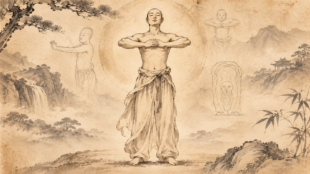
For some time, I have been exploring connected extension through standing meditation, or Zhan Zhuang (站樁). I work with a sensation of stretching through the fingers into the arms and shoulders, extending through the back, and simultaneously through the toes, legs and hips. The dantian provides an experiential centre around which these relationships can be organised. Sometimes the sensation is of extending outwards from that centre; sometimes it feels as though the body is drawing inwards towards it. Quite often, I allow the body to determine how these relationships develop rather than consciously directing every aspect of the movement.
One of the most interesting qualities of this practice is that extension and release do not necessarily seem to be opposites. I can experience a connected stretch through the body while allowing muscular effort to diminish. Indeed, sometimes releasing the muscles makes the sensation of extension more apparent. This is something I have been exploring for some time, but Mitchell’s lecture offered a particularly useful way of reconsidering what might be happening.
In introductory standing meditation, we are sometimes taught to align the body by stacking the bones, allowing the skeletal structure to support our weight as the muscles relax. Mitchell challenges this approach, arguing that simply allowing the skeleton to settle downwards under gravity can encourage the joints to close rather than open. His alternative is expressed through a wonderfully simple instruction: bones up, flesh down.
The skeleton is organised so that it feels as though it is rising, floating or expanding, while the muscles are encouraged to soften and hang from that structure. Rather than the entire body sinking together, there is a complementary relationship between skeletal expansion and muscular release. The result, according to Mitchell, is an internal stretch within the tissues he describes as huang (肓), a term associated with the membranous or connective dimensions of the body in traditional Chinese cultivation theory.
What resonates with me is not simply the idea of stretching internally, but the way that stretch arises. Instead of deliberately pulling tension through the body, we create the conditions in which extension can emerge through the relationship between an expansive skeletal structure and relaxed musculature. There is still physical work involved, but the emphasis shifts from generating muscular tension to organising the body so that connection becomes perceptible without being forced.
I find this a particularly compelling distinction because it corresponds with something I have noticed in my own practice: the sensation of internal extension can become more continuous precisely when I stop trying so hard to produce it.
The relationship between qi and huang
Mitchell’s wider explanation concerns the relationship between qi (氣) and huang. Within his interpretation of the Yi Jin Jing, the cultivation of qi and the development of the huang are mutually supportive processes. Appropriate physical organisation creates the conditions for this relationship to develop, while qi is understood to lead the longer process of bodily transformation.
An important distinction here is that Mitchell is not suggesting that practice begins somewhere other than the physical body. We have to begin with the body because it is what we have available to work with. Rather, his argument is that conventional muscular strengthening is not the primary starting point for the kind of transformation described in the Yi Jin Jing. Instead, physical organisation creates the conditions through which a different process of cultivation is intended to unfold.
This is where I currently find myself in the practice. I am interested in developing the relationship between skeletal expansion, muscular release and the internal sensations associated with the huang. I am not claiming to have reached the more advanced stages of transformation that Mitchell describes, nor do I presume that my experience of internal stretching necessarily demonstrates the development of qi in any particular sense.
The terminology is also worth approaching carefully. Huang should not automatically be equated with fascia or any single structure recognised by contemporary anatomy, just as the traditional relationship between qi and huang should not be presented as an established physiological mechanism. Nevertheless, Mitchell’s explanation offers a useful framework for investigating the qualities of movement and bodily attention that are already accessible through practice.
For me, the important discovery is that the sensation of internal connection may not need to be actively manufactured. Perhaps the more interesting task is to establish the conditions in which it can emerge.
Taking the principles into movement
Although Mitchell’s lecture concentrates on the underlying process theory rather than the familiar twelve movements, it has prompted me to reconsider how I approach the Yi Jin Jing itself. This is my own developing enquiry rather than an instruction drawn directly from his teaching.
In standing meditation, the relative stability of the posture allows time to explore the relationship between skeletal expansion, muscular release and internal extension. The twelve movements introduce different conditions. The arms extend and return, the body turns, weight shifts, and the relationship between the centre and extremities continually changes.
I am particularly interested in how the qualities encountered through standing practice might be carried into these movements. Can the skeleton retain a sense of expansion as the body turns? Can the muscles remain soft and responsive while the arms extend? Can the feeling of internal connection continue through the alternation between stretching and releasing?
Turning and torsion add another dimension. As the body rotates, different relationships of extension become apparent, and the sensation of connection may change direction or quality. Rather than deliberately increasing the intensity of the stretch, I am interested in listening to how the movement reorganises the body and whether the internal sensation can remain continuous without unnecessary muscular effort.
This returns me to something that has become increasingly important in my wider practice: the distinction between directing movement and allowing movement to develop. I may begin with an intention to extend or release, but I do not always want to determine in advance exactly how the body should respond. Sometimes the most interesting sensations arise when I become less concerned with producing a particular result and more attentive to what the movement itself reveals.
The twelve Yi Jin Jing movements offer a changing structure within which to investigate these relationships. Standing meditation provides an opportunity to become familiar with the qualities of expansion and release, while movement challenges us to explore how those qualities might persist through changing positions, directions and demands.
Creating the conditions for transformation
What I take from Mitchell’s lecture is not a new set of exercises or a technique that I can simply add to my existing routine. It is a different way of considering the purpose of the practice. Rather than approaching the Yi Jin Jing primarily as a sequence of movements through which physical benefits are accumulated, I am becoming interested in how those movements might create the conditions for a more fundamental reorganisation of the body.
The principle of bones up, flesh down offers me a particularly useful point of entry. It suggests that expansion and release can coexist, that muscular relaxation need not mean collapse, and that the sensation of internal stretching may become more apparent when the body is organised appropriately rather than subjected to increasing effort.
I am conscious that this is only one aspect of the much wider process Mitchell describes, and that my understanding remains provisional.
This article is a reflective enquiry into Yi Jin Jing and the internal arts, drawing principally on Damo Mitchell’s interpretation of traditional cultivation theory and my own experience of standing meditation and movement practice. The theoretical concepts discussed should not be interpreted as established scientific descriptions of anatomy or physiology. The article is not intended as medical or rehabilitation guidance, and physical practices should be approached in accordance with individual health circumstances and appropriate professional advice.
The lecture discussed here is the work of Damo Mitchell and The Internal Arts Academy. The interpretations concerning the application of its principles to the twelve Yi Jin Jing movements are my own developing reflections and should not be attributed to Mitchell.




 China Tai Chi Guide
 Five Elements Academy
 Long Tou Shan Tai Chi School
 Seven Stars Internal Arts
 Traditional Tai Chi School
 Wandering Dao, China