Can you learn the Yi Jin Jing from two good videos and twelve images from a nineteenth-century manual? Perhaps the more useful question is what, exactly, those resources can teach. They can introduce the sequence and help us recognise the outer shapes of its movements. They can also begin something less obvious: learning to pay attention to how a movement feels. But they cannot observe our bodies, correct our mistakes or replace the responsiveness of a good teacher.
I have recently been learning the twelve movements through two recordings by Shi Heng Yi and Shaolin Temple Europe, made at the temple in Otterberg, Germany. One is a complete demonstration, recorded in June 2017; the other is an explanatory presentation recorded during a qigong retreat in July 2018. Both are freely accessible on YouTube, and I have found their combination unusually helpful. The first lets me see the rhythm and continuity of the practice. The second allows me to return to individual movements and examine the teaching more carefully (Shaolin Temple Europe, 2017, 2018).
I wanted to bring these recordings into conversation with something much older: the twelve historical illustrations reproduced in Pei-San Ng’s dissertation, Strength From Within (2016). They come from Wang Zuyuan’s nineteenth-century presentation of the Yi Jin Jing, and are accompanied by brief verses about posture, force, gaze, breath and intention. The visual gap between the printed figures and the moving bodies on screen is itself instructive. The illustrations are not photographs of the present-day routine, nor do they completely specify how to execute each exercise. They are prompts for understanding a changing practice, not a substitute for contemporary instruction.
Two videos to learn with
1. Complete demonstration (2017)
2. Full explanations (2018)
Why look at the older illustrations?
The Yi Jin Jing (易筋經), usually rendered as the Classic of Transforming the Sinews, has often been attributed to Bodhidharma and the Shaolin tradition. The textual history is more complex than that origin story suggests. Ng (2016) describes how the illustrated twelve-form version circulated through nineteenth-century publications, while Shahar (2008) situates the wider textual tradition within the intersecting histories of martial practice and bodily cultivation. The drawings reproduced here are from that later illustrated tradition, not evidence of a sixth-century exercise manual.
What makes the historical material valuable for learners is that it does more than identify poses. In Ng’s translation, the instructions repeatedly direct the practitioner’s attention to the activity of the shoulders and back, to breathing, to the gaze, and to the idea of exerting force without necessarily moving a heavy object. This is an account of a body experienced from within as well as seen from without. It also contains instructions — including strong exertion and forceful gaze — that should be understood in their historical context, not followed uncritically as contemporary health advice (Ng, 2016, pp. 39–42, 131–134).
How to use this guide
My suggestion is to use the two films differently. Begin by watching the demonstration without trying to follow every detail; notice the overall pacing, the transitions and the way the twelve movements form a sequence. Then use the explanation video to study one or two movements at a time. Revisit the demonstration afterwards, asking whether the action now looks different. Only then turn to the historical image and the short reflection below: not as an additional command, but as a question to bring into your own observation.
The notes beside the images are not translations of the historical verses, nor claims about what Shi Heng Yi instructs in any particular moment of the recording. They are my suggested sensory enquiries, informed by the historical imagery and my own experience of taiji, standing practice and neigong. They describe things a learner might notice, not sensations everyone ought to produce. There is no special prize for feeling a pull, a tingling sensation or an extraordinary state of mind. The task is to become more precise about what is actually occurring.
The twelve forms: What to notice
1. Wei Tuo Presenting the Pestle — Frontways
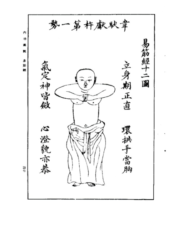
Historical title: First Pose: Wei-tuo Presents the Staff
Gathering without gripping. The hands come together in front of the body. Notice whether the elbows, shoulders and upper back can remain available rather than becoming fixed. Does bringing the arms in towards the centre feel like compression, concentration, or simply a quieter organisation of the body? Observe the contact of the feet with the floor while the upper body settles.
Historical image 1. Reproduced in Ng (2016), Figure 2, from Wang Zuyuan’s nineteenth-century Yi Jin Jing images, C. V. Starr East Asian Library, UC Berkeley.
2. Wei Tuo Presenting the Pestle — Sideways
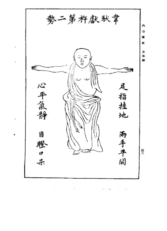
Historical title: Second Pose: Wei-tuo Presents the Staff
Opening without losing the centre. As the arms open, attend to the relationship between fingertips, shoulders and the space across the chest. Does widening the arms also change the sensation through the back? The useful question is not how far you can stretch, but whether the extension remains connected and the breath remains unforced.
Historical image 2. Reproduced in Ng (2016), Figure 2, from Wang Zuyuan’s nineteenth-century Yi Jin Jing images, C. V. Starr East Asian Library, UC Berkeley.
3. Wei Tuo Presenting the Pestle — Upwards
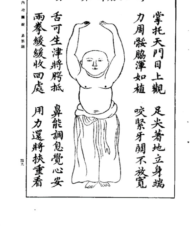
Historical title: Third Pose: Wei-tuo Presents the Staff
Lengthening and grounding together. The upward direction encourages a sense of length through the whole body. Observe whether rising through the arms alters how you sense the weight in your feet. The historical text evokes exertion as if lifting something heavy; for a contemporary learner this can be considered an image of intention, not an invitation to strain or hold the breath.
Historical image 3. Reproduced in Ng (2016), Figure 2, from Wang Zuyuan’s nineteenth-century Yi Jin Jing images, C. V. Starr East Asian Library, UC Berkeley.
4. Plucking Stars on Each Side
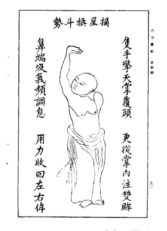
Historical title: Fourth Pose: Plucking a Star and Switching to the Dipper
Asymmetry and the moving axis. One side lengthens while the other responds. Notice how the torso reorganises as the reach changes sides. Is the sensation concentrated in the extended arm, or does it involve the ribs, back and standing legs? Let the eyes observe the movement without demanding an extreme neck rotation.
Historical image 4. Reproduced in Ng (2016), Figure 2, from Wang Zuyuan’s nineteenth-century Yi Jin Jing images, C. V. Starr East Asian Library, UC Berkeley.
5. Pulling Nine Cows by Their Tails
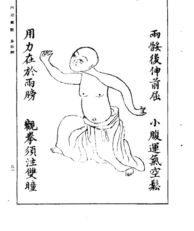
Historical title: Fifth Pose: Dragging Backwards the Tails of the Nine Oxen
An imaginary resistance. The title suggests a considerable opposing force, but this does not require a maximal muscular pull. Explore the sense of connection between the hands, shoulders, trunk and legs while the body changes direction. Can you perceive resistance without turning the abdomen and chest into a rigid brace?
Historical image 5. Reproduced in Ng (2016), Figure 2, from Wang Zuyuan’s nineteenth-century Yi Jin Jing images, C. V. Starr East Asian Library, UC Berkeley.
6. Displaying Claws and Spreading Wings
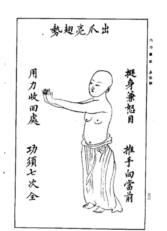
Historical title: Sixth Pose: Extending Talons and Spreading Wings
Opening the hands, releasing the shoulders. The striking quality is the expression through the fingers and palms. Notice how the hands change the experience of the forearms and shoulder girdle. When the arms return, does the sense of extension vanish, or can some connection remain even as muscular effort softens?
Historical image 6. Reproduced in Ng (2016), Figure 2, from Wang Zuyuan’s nineteenth-century Yi Jin Jing images, C. V. Starr East Asian Library, UC Berkeley.
7. Nine Ghosts Drawing Swords
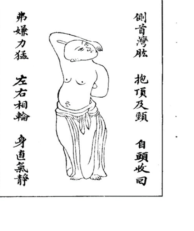
Historical title: Seventh Pose: Nine Demons Drawing a Dagger
Complexity without contortion. The arms and upper body create a more complicated arrangement. The historical image asks us to consider how the shoulders and back respond to asymmetrical positioning. Rather than chasing an impressive stretch, pay attention to the smallest comfortable version that preserves easy breathing and a sense of balance.
Historical image 7. Reproduced in Ng (2016), Figure 2, from Wang Zuyuan’s nineteenth-century Yi Jin Jing images, C. V. Starr East Asian Library, UC Berkeley.
8. Placing Three Plates on the Floor
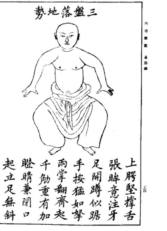
Historical title: Eighth Pose: Three Dishes Falling to the Ground
Weight, support and the legs. Here gravity becomes unmistakable. Notice how the feet, knees, hips and torso share the task of lowering and rising. Can the legs work while the jaw, neck and breathing remain comfortable? The historical verse imagines great weight; the useful feeling to investigate is controlled support, not heroic effort.
Historical image 8. Reproduced in Ng (2016), Figure 2, from Wang Zuyuan’s nineteenth-century Yi Jin Jing images, C. V. Starr East Asian Library, UC Berkeley.
9. Black Dragon Displays Its Claws
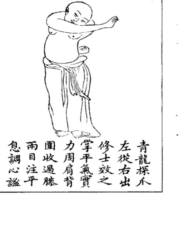
Historical title: Ninth Pose: The Azure Dragon Extends Its Claws
Rotation and continuity. The turning action offers a way to observe how the arms and back participate in the movement of the torso. Does the rotation feel localised, or can you sense a relationship through the feet and hips? Keep the turn small and easy: reaching farther or twisting the neck more is not the point.
Historical image 9. Reproduced in Ng (2016), Figure 2, from Wang Zuyuan’s nineteenth-century Yi Jin Jing images, C. V. Starr East Asian Library, UC Berkeley.
10. Tiger Jumping on Its Prey
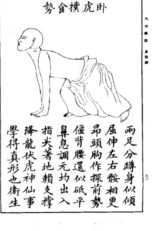
Historical title: Tenth Pose: The Crouching Tiger Pounces on Prey
Readiness without rushing. The body takes on a more committed forward-oriented shape. Rather than thinking of speed or aggression, notice the organisation of weight and the possibility of moving in different directions. The image of a tiger can evoke readiness, but readiness need not depend on holding the body rigid.
Historical image 10. Reproduced in Ng (2016), Figure 2, from Wang Zuyuan’s nineteenth-century Yi Jin Jing images, C. V. Starr East Asian Library, UC Berkeley.
11. Bowing Down in Salutation
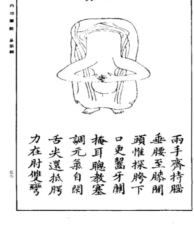
Historical title: Eleventh Pose: To Bend the Bow
Yielding to gravity. The body folds, changing the usual relationship between head, spine and feet. Notice what becomes easier to perceive when the upright orientation is altered. This is an especially important movement to modify or omit where bending causes symptoms or strain; the experience of yielding can be explored in a much smaller range.
Historical image 11. Reproduced in Ng (2016), Figure 2, from Wang Zuyuan’s nineteenth-century Yi Jin Jing images, C. V. Starr East Asian Library, UC Berkeley.
12. Swinging the Tail
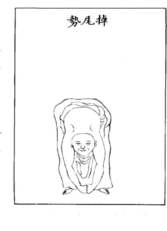
Historical title: Twelfth Pose: Wagging the Tail
Continuity into stillness. The final movement invites attention to the relationship between extension and the gradual completion of the sequence. As the exercise ends, notice whether the body needs to become rigid in order to stop. What remains perceptible when movement ceases? Perhaps nothing unusual; perhaps the sense of a connected, available stillness.
Historical image 12. Reproduced in Ng (2016), Figure 2, from Wang Zuyuan’s nineteenth-century Yi Jin Jing images, C. V. Starr East Asian Library, UC Berkeley.
Can you learn this way?
How, then, should a beginner learn with these limited resources? I would resist the temptation to learn all twelve forms in one sitting. Study a small section, compare the guided explanation with the complete demonstration, and return to it across several sessions. The historical illustrations can help you remember the order and invite reflection, but they cannot reveal timing, muscular effort or safe joint range on their own. A teacher who can see you practise remains valuable, particularly where an apparently small change in posture makes a substantial difference.
I also think it helps to separate three questions: Am I approximating the movement shown? Can I perform it with controlled, comfortable effort? And what do I notice while I am moving? The first is about recognition, the second about skilful physical organisation, and the third about attention. Video is strongest for the first; a competent teacher is especially useful for the second; the third requires a willingness to listen to the body rather than manufacture a sensation.
In my own early practice, the most compelling discovery has come after the movements rather than within any single posture: a sense of stillness that felt full of potential. I do not regard that as the outcome the Yi Jin Jing ought to produce for everybody. If anything, it has made me less interested in chasing an effect and more interested in the changing relationship between extension, release and attention. The body is not simply a mechanism executing twelve instructions. It is also the place in which those instructions become an experience.
So yes, I think these resources are enough to begin — provided beginning is understood as a process of modest, attentive learning rather than complete mastery. Watch the movement, learn its outline, encounter its historical image, and notice how it feels. Then return to the movement. What changes on the second or third encounter may be the most useful lesson of all.
References
Ng, P.-S. (2016). Strength from within: The Chinese internal martial arts as discourse, aesthetics, and cultural trope (1850–1940) [Doctoral dissertation, University of California, Berkeley]. eScholarship. https://escholarship.org/uc/item/6r34f83d
Shahar, M. (2008). The Shaolin monastery: History, religion, and the Chinese martial arts. University of Hawai‘i Press. https://doi.org/10.21313/hawaii/9780824831103.001.0001
Shaolin Temple Europe. (2017). 易筋經 · Yi Jin Jing (Muscle Tendon Change Classic) Qi Gong [Video]. YouTube. Performed by Shi Heng Yi and students. https://www.youtube.com/watch?v=GvQUttWLVWc
Shaolin Temple Europe. (2018, July 16). 易筋經 · Yi Jin Jing (1–12 · Full Explanations) [Video]. YouTube. Instruction by Shi Heng Yi. https://www.youtube.com/watch?v=Ez6NYcasyhs
Image credits and reuse
All twelve illustrations reproduced as Figure 2 in Ng (2016), from Wang Zuyuan’s nineteenth-century Yi Jin Jing images, held at the C. V. Starr East Asian Library, University of California, Berkeley. Please confirm reproduction permissions before publishing cropped extracts on WordPress.